
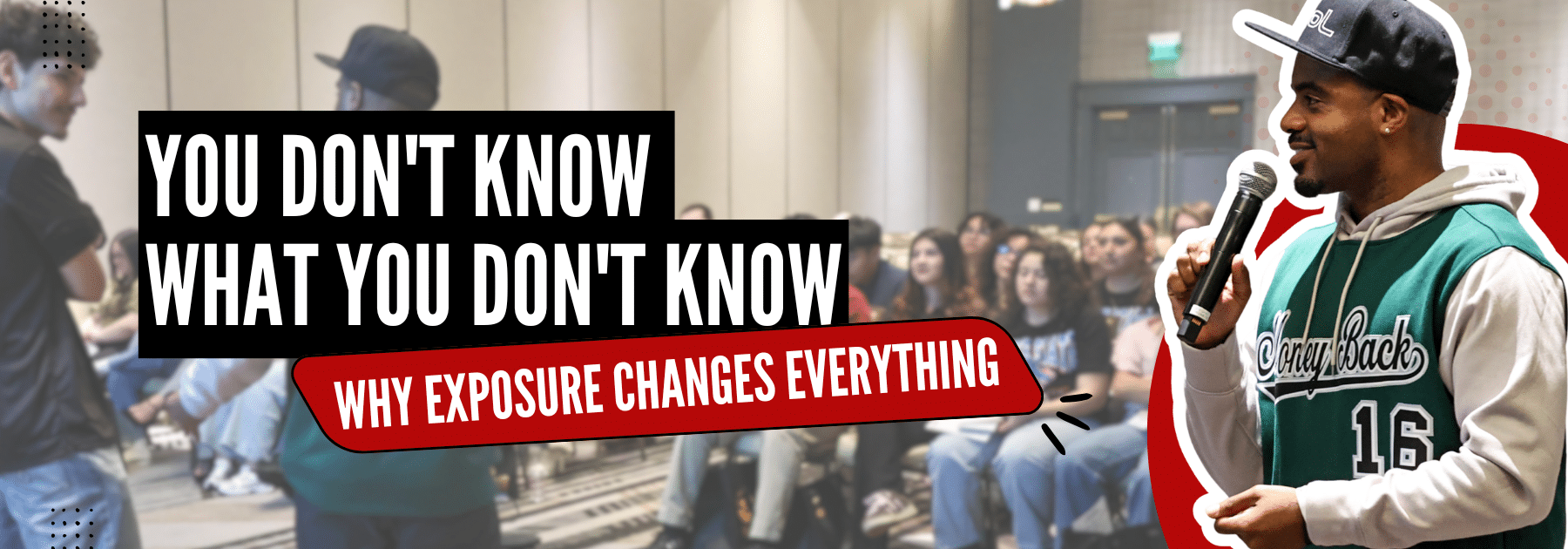
For Financial Literacy Month, we sat down with MJ Bridges, founder of Young & Debt Free, following a recent community event in Racine that brought his work to life in a powerful way.
In collaboration with a weekly karaoke night at Kings Kitchen & Cocktail, MJ and Young & Debt Free invited community members, educators, and college tour alumni to come together… not just to celebrate, but to invest. The night honored the longevity and impact of the college tour experience, culminating in a $1,000 donation to support future students.
That moment wasn’t just about giving back but about vision. MJ shared his goal of building stronger partnerships to fully subsidize college tours, removing financial barriers so more students can access life-changing opportunities.
In this conversation, MJ breaks down why experiences like HBCU college tours matter, especially for first-generation students, and how financial literacy connects directly to access, exposure, and long-term success. This isn’t theory. This is lived experience, real impact, and how #GEARUPworks for what happens when students are given the chance to see more.
Why Does Exposure to HBCUs Matter?
Let’s get to it. I’m going to answer this question twofold, because, simply, you don’t know what you don’t know. Most HBCUs are centered in the Southern and Eastern parts of the United States, with only a few in the Midwest. They’re not out west, not in the Northwest, not in the upper Midwest or far northeast. So, a lot of people just don’t know about them. They’ve never heard of them or experienced the culture. For first-generation students, that exposure is everything. It lets them know this is even an option, and once they know, we can help them see that this is also a place of excellence. HBCUs produce 50% of Black teachers, over 80% of Black judges, around 50% of Black doctors and lawyers, and 40% of Black engineers. That’s not small, that’s excellence.
What Happens When You Finally See Yourself in the Space?
Let me take a step back. I’m from Wisconsin, but when I say that, people ask me if there are Black people there. And I get it. There’s not much representation. Growing up, I had three Black teachers from K–12, all women. I never had a Black male teacher in an academic setting. And that matters. When you’re a young Black male, seeing someone who looks like you in those roles builds comfort and connection. So, when I stepped onto an HBCU campus as a teenager, it was like, wait, what? A place of higher learning where everyone looks like you, where there’s pride, where people challenge you and remind you that you’re gifted. That was one of the first times I truly felt like I mattered. I had seen it in movies, but experiencing it in real life? That changes you.
Let me add something else: The “H” stands for historical. A lot of these institutions were founded by former slaves. The university I attended, Alabama State University, was founded by nine former slaves in Montgomery, Alabama. Think about that. After 1865, after the war, they came together, built community, and created a school of higher learning. And now, generations later, we’re still benefiting from that legacy. That’s powerful. When students understand that history, they’re not just visiting a campus, they’re stepping into something bigger than themselves.
How Does This Shape the Work I Do Today?
It shapes everything. My purpose is to help students get to and through college successfully. That’s what drives the financial literacy workshops, the college tours, the conversations. It’s about exposure: helping students see different campuses, understand costs, and find what fits them. Because when I was walking through dorms, sitting in student unions, seeing the history and the people, I could finally picture myself there. That belief, “I can do this”, is what changes everything. And that’s what I try to create for every student I work with.
How Do We Bring Hope Back into Our Communities?
I’m from Racine, Wisconsin, and I love my city! But we’ve got challenges. High poverty rates, limited access to higher education, and sometimes a lack of hope. Only about 21% of residents have a degree beyond high school. So, for a lot of students, success doesn’t even feel like an option. That’s why I do this work, to inject hope. To show students that they can go there, that they belong in those spaces. Not just say it, but create opportunities for them to experience it for themselves.
Do College Tours Actually Work?
Let me be clear, the college tour works, and I’m a prime example. I attended the same type of tour I donated to twice. I also went on tours through programs like GEAR UP and others. And I ended up attending one of the universities I visited. That exposure led to my success. So when I say this matters, I’m not speaking theory, I’m speaking lived experience. When students see it, it becomes real. And when it becomes real, they start making different decisions.
Why Does It Take a Community to Make This Work?
I’m a product of my community. My mom, my aunt, my grandma, and all the programs and people who poured into me. The YMCA, workforce programs, youth organizations, GEAR UP… those spaces helped shape me. So now it’s my responsibility to give back and bring people together. This work is about community. It’s about building something bigger, raising funds, and making sure students can access opportunities like college tours without cost being the barrier.
What’s Next for Young & Debt Free?
So what’s next? You’re going to see another Young & Debt Free Week in the 262 community. We’ve done it before: five days of workshops covering budgeting, credit, cost of college, plus fitness and social events and we’re bringing it back in 2026. It’s about bringing the community together for real conversations around money, health, and mindset. And most importantly, it’s about continuing to create spaces where students can see what’s possible for their future.
MJ’s message is clear: financial literacy isn’t just about managing money, it’s about expanding what students believe is possible.
The recent Racine event was more than a celebration; it was a step forward. With community members showing up, a $1,000 contribution made, and a shared vision to grow partnerships that can fully subsidize future college tours, the momentum is building.
Because when access increases, belief follows.
As we recognize Financial Literacy Month, this is a reminder that real impact happens when communities come together, not just to talk about opportunity, but to fund it, build it, and make it real for the next generation.
To learn more about MJ Bridges and Young & Debt Free, or to bring this work to your students and community, connect with the team and be part of building the next generation of financially confident, college-ready leaders.

0 Comments