
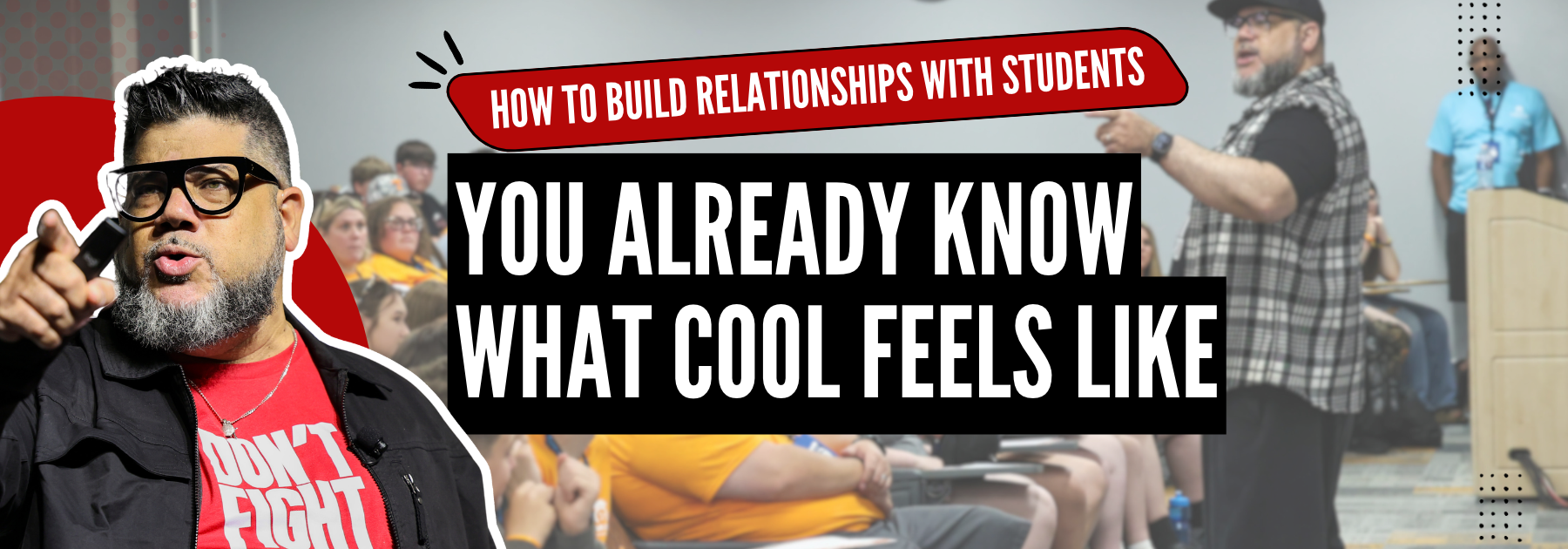
Blog contributed by Carlos “Chu” Ojeda Jr., CEO of CoolSpeak and author of An Educator’s Guide to Being COOL & Making It HIP
Think about an adult who changed your life.
Don’t start with the person who had the best classroom decorations or the most entertaining presentation. Think about the person you still remember because of something they did for you.
Maybe they stayed after class. Maybe they noticed you were having a rough day. Maybe they challenged you when you were ready to quit.
You remember their name, and you probably remember how you felt around them.
That feeling is where I want us to start.
Building meaningful relationships with students doesn’t require a special personality or an entertaining teaching style. It requires intentional, consistent behaviors that help students feel seen, respected, and supported.
That’s what I mean when I talk about being COOL.
What Does It Mean to Be a COOL Educator?
When I named my company CoolSpeak, I knew the word cool would create expectations. People hear it and immediately think about fashion, slang, humor, or somebody who can walk into a room and own it.
I get it. Those are the images we usually attach to the word.
But the cool in CoolSpeak has always been about the connections we make with students, families, and educators.
Being a COOL educator means building relational credibility through consistent actions that demonstrate care, respect, and authenticity.
That’s the definition I explore in Chapter 1 of my new book, An Educator’s Guide to Being COOL & Making It HIP.
When a student says a teacher is cool, listen a little deeper.
They may be telling you that the teacher makes time for them. That the teacher is fair. That the teacher explains something again without making them feel stupid.
Students might not use the phrase relational credibility, but they recognize it. They know which adults treat them like human beings. They also know which adults need an audience more than they want a relationship.
And there’s a big difference.
How Do Educators Build Meaningful Relationships With Students?
I believe most educators already know what connection feels like because somebody gave it to them. The challenge is slowing down long enough to understand what that person actually did.
We remember the feeling, but we don’t always examine the behaviors that created it.
If we skip that examination, we can end up copying the surface of somebody’s approach while missing the reason it worked. We imitate their jokes when what mattered was their patience. We borrow their activity when what mattered was their follow-through.
Try this reflection activity: Remember the Person Before You Copy the Technique
Write down the name of one adult who made you feel seen. Then describe what they did in plain language.
Don’t stop at a word like supportive. What did support actually look like?
- Did they ask a question and wait for the answer?
- Did they help you prepare for something important?
- Did they correct you without embarrassing you?
- Did they remember something that mattered to you?
The more specific you become, the more useful that memory becomes.
Now you have something you can practice instead of a personality you think you need to borrow.
For me, when I think back to the “crazy Puerto Rican lady” from my story, I remember the patience she showed when working with me.
I remember the cultural relevance and respect she demonstrated when speaking to my family in Spanish. I remember the love I felt when she took a moment to offer positive affirmations whenever doubt started creeping in.
Those weren’t just memories. They were behaviors.Behaviors I could practice to become better at connecting with students.
That distinction matters because too many caring adults have disqualified themselves from connection. They tell themselves they’re too quiet, too serious, too old, or too awkward.
Somewhere along the way, they decided that engaging students requires a certain kind of personality.
It doesn’t.
A quiet educator can make a student feel deeply understood. A demanding educator can create tremendous trust.
The question is whether students experience care and consistency from the person standing in front of them.
Why Are Teacher-Student Relationships Important for Student Engagement?
Positive teacher-student relationships help create the trust and sense of belonging students need to participate, ask questions, take academic risks, and engage in learning.
Students are paying attention long before the lesson begins.
They notice how you greet somebody who arrives late. They notice whether your patience changes depending on who’s asking the question. They notice how you respond when the answer is wrong.
None of those moments may appear in your lesson plan, but they help students decide what kind of experience they’re likely to have with you.
Long before they volunteer an idea, they’re gathering evidence about whether taking that risk will be worth it.
Picture a student who asks you to explain something a second time. You can repeat the explanation while looking irritated, or you can acknowledge the question and try another way.
The information may be similar. The experience is different.
In the second interaction, the student gets an explanation and a message about belonging: You are allowed to need help here.
That message matters the next time the student is confused. It can make asking a question feel possible instead of embarrassing.
Consistency Builds Trust With Students
Connection grows when those small moments become dependable.
A warm greeting on Monday is a beginning. Remembering the student’s name and treating them with dignity on Thursday gives that greeting credibility.
This is why I describe cool as relational credibility delivered consistently.
Students need enough experience with our actions to believe our intentions. We cannot expect one encouraging conversation to erase months of feeling overlooked. But we can give them another experience, and then another, until a different pattern becomes believable.
And sometimes, building trust means being willing to repair it.
Maybe you interrupted a student. Maybe you dismissed a question because you were rushing.
You don’t have to defend the interaction simply because you’re the adult. Acknowledge it. Return to the student. Explain what you should have done differently, and do it differently next time.
An apology supported by changed behavior teaches students that their experience matters.
It also shows them that credibility can include ownership of mistakes.
5 Simple Ways to Build Stronger Connections With Students
If you’re wondering how to start building better relationships with students, you don’t need to redesign your entire classroom or become a different person. Start with the small interactions students experience every day.
Here are five practical ways to make connection more intentional:
- Learn and use students’ names.
Acknowledge students as individuals, not just as names on a roster or grades in a system.
- Listen without preparing your response.
Give students your attention. Ask a question and allow them the time to answer.
- Follow up on something that matters to them.
If a student mentioned something important yesterday, ask about it today. Show them that what they share doesn’t disappear the moment the conversation ends.
- Correct students without embarrassing them.
You can maintain high expectations while protecting a student’s dignity. Accountability and care can exist in the same interaction.
- Be consistent, especially when it’s difficult.
A single positive interaction is a start. Repeated actions are what make your intentions believable.
None of these strategies requires you to be the loudest, funniest, or most charismatic person in the room.
They require you to be intentional.
And that’s something every educator can practice.
Try This Student Connection Activity This Week
Here’s where I would start.
Choose one behavior from the adult you remembered at the beginning of this article and make it visible in your own practice.
If they listened, create a moment where you listen without checking your phone or preparing your response.
If they followed up, ask about something a student mentioned yesterday.
If they challenged you, offer a student a demanding task with the support needed to attempt it.
Keep the action small enough to repeat. You’re building a habit students can experience, not planning a dramatic reveal. And pay attention to whom you choose.
It’s easy to connect with students who already enjoy talking to you.
Look for somebody you know mostly through a grade, a referral, or a seat in the back of the room.
You don’t need to force an intimate conversation. Start with a respectful question or a genuine acknowledgment. Then leave room for the student to respond in their own time.
Connection is an invitation. Students shouldn’t have to perform gratitude or immediate trust to deserve your continued effort.
How Do You Know If Your Efforts Are Working?
At the end of the week, ask yourself three questions:
- Did I consistently practice the behavior I committed to?
- Did I learn something new about a student?
- Did I recognize an assumption I had been making?
Be careful about measuring success only through a visible student response. Some students will open up quickly. Others will watch for a while.
Your responsibility is to keep offering credible evidence that you’re someone who cares. The relationship needs time to become something they can lean on.
Connection Comes Before Student Engagement
There’s a progression I want educators to understand:
Connection → Trust → Engagement → Growth
When students experience consistent care and respect, we help create the conditions for trust. That trust can make it easier for them to participate, ask questions, and attempt difficult work.
This is why connection belongs inside the work of education.
It deserves the same intentional attention we give our content because students experience the person and the lesson together.
And it’s why I wrote An Educator’s Guide to Being COOL & Making It HIP.
I wanted educators to recognize that the connections they admire in others aren’t magic. They’re built through intentional behaviors that can be understood, practiced, and strengthened.
Being COOL is about connection. Making it HIP, High Impact Programming, is about designing meaningful experiences that build on that connection.
We need both. So return to the person whose name you wrote down. What would you thank them for today?
Chances are, the answer tells you something about the educator you want to become for somebody else.
You already know what cool feels like. Now give that feeling a behavior. Give that behavior consistency. And give a student the opportunity to experience it.
Years from now, somebody may remember your name for a reason you barely noticed at the time.
And it may have started with the interaction right in front of you.
Keep Building Connection With Your Students
In An Educator’s Guide to Being COOL & Making It HIP, Carlos Ojeda Jr. shares practical strategies, real experiences, and tools to help educators build meaningful relationships and create high-impact learning experiences.
“Because I don’t believe in magic. I believe in educators. I believe in you.”
Explore the book and start putting COOL and HIP into practice.

0 Comments