
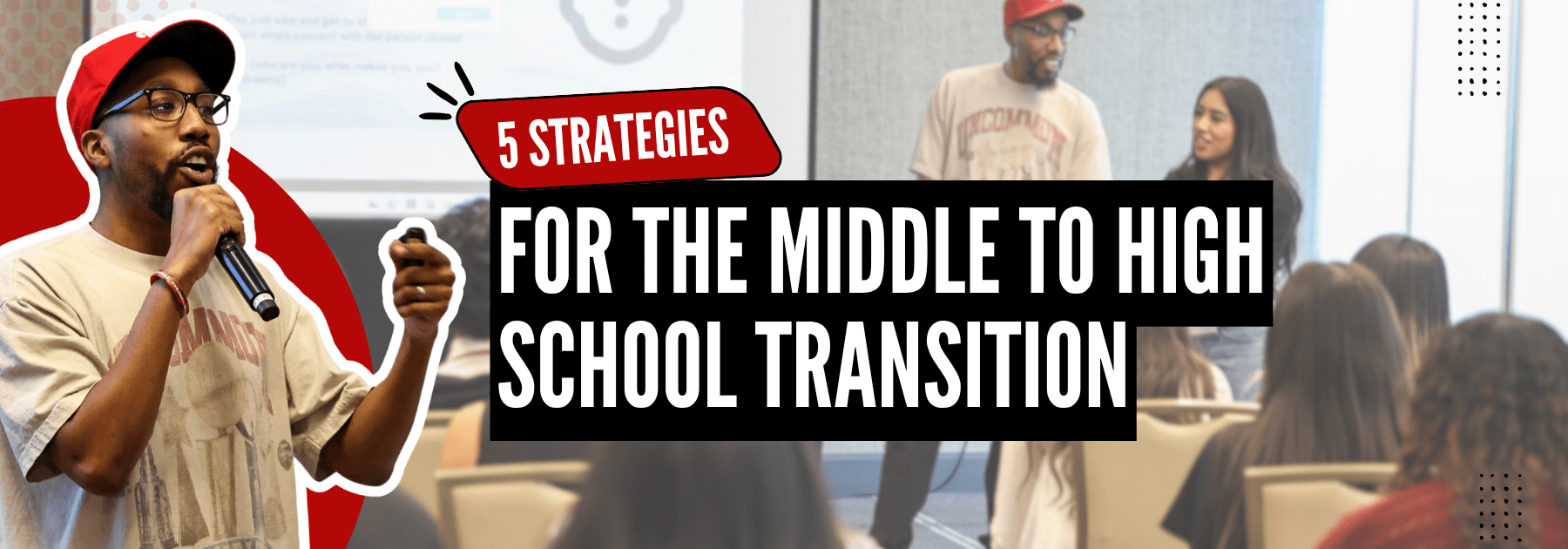
At CoolSpeak, we talk a lot about the power of relationships, especially during the moments when students are navigating change, uncertainty, and everything that comes with growing up. Few transitions bring all of those things together quite like the move from middle school to high school. CoolSpeaker Sam Brown knows that transition from both sides.
Today, I work with students to help them navigate change, build confidence, and recognize the opportunities that can exist on the other side of fear. But long before I was helping students through their transitions, I was a student trying to navigate one of my own.
Let me share how one educator changed the direction of my story and five strategies educators can use to help students enter high school ready to become storm-resistant.
In 8th grade, I got expelled from my school district. There’s only one high school in my hometown, so that wasn’t an option anymore. I ended up at Sankofa Academy Charter School in West Chester, a school for students with behavioral issues.
Truth is, I’d been struggling since 6th grade at South Brandywine Middle School in Coatesville, PA. My behavior was up and down, and a lot of people didn’t know why. I had lost my dad, and I didn’t have the tools yet to deal with that, so it came out sideways in class, in the office, wherever I was.
What actually turned things around for me wasn’t a program or a policy. It was one person.
My assistant principal, Bridgette Miles, held me accountable every time, but she also heard me out every time. She knew my family, and she knew about my dad’s passing. When I landed in In-School Suspension (ISS), she made sure I still did my work, every assignment, and my grades didn’t drop because she wasn’t going to let that happen on her watch.
Honestly, there were days in her office when I just wanted her to let them suspend me. It would’ve been easier. She didn’t let me take the easy way out. That relationship – accountability plus actually being seen – carried me through 9th, 10th, and 11th grade. It’s a big reason I made it back into my home district and graduated.
Now that I work with students, I understand why that mattered so much. A steady, positive adult relationship is a protective factor, and it matters most in the moments students are least likely to ask for it.
The transition from middle school to high school is one of those moments.
I’ve now sat on both sides of this transition, first as the student and now as the professional working alongside schools, and I’ve learned that walking into high school isn’t just about entering a bigger building with a harder workload.
It’s new social dynamics. More independence with less oversight. A shifting sense of identity. New expectations. New pressures. And situations outside the classroom that no curriculum map can fully prepare a student for.
We have to prepare students for the schedule, the workload, and the academics. But we also have to prepare them for whatever the experience actually brings.
We have to help students become storm-resistant, and here are 5 ways to bring this into your classroom this year, without adding more to your plate.
1. The Probing Question
Instead of just telling students what high school will be like, ask them questions that get them thinking about it for themselves. Something as simple as “What are you most nervous about for high school, and what’s one thing you’re looking forward to experiencing your first year?” opens the door for students to name what’s actually going on for them, not what they think they’re supposed to say.
This builds self-awareness: the ability to name a feeling before it turns into a bigger problem later.
2. The Time Capsule
At the start of the year, have students put together a few things for a time capsule: what they want to accomplish in their last year of middle school, how they want their first year of high school to feel, and one thing they’re worried about that they’d like to look back on later.
Seal it and open it together at the end of the year. Students can reflect on what changed, what came true, and what they learned about themselves along the way.
This builds ownership: students start to see themselves as active participants in their own transition, not just passengers along for the ride.
3. Weaving It Into What You’re Already Teaching
Preparing students for next stages doesn’t have to be a separate lesson. It can live inside what’s already happening in the classroom.
An English teacher discussing a character who’s navigating a major life change can pause and connect it back to what students are about to walk into themselves. A gym teacher can turn a competitive activity into a team-building moment, using the lesson of working through pressure or unfamiliar teammates as a direct parallel to what high school will ask of them.
This builds transfer: the ability to take what they’re learning and apply it to their own life, not just to a test.
4. The Steady Check-In
Build a short, consistent check-in into the first three to five minutes of class. It doesn’t have to be long or formal. The point isn’t the content of the check-in; it’s the consistency of it.
Over time, students learn that someone is paying attention to them as a person, not just as a name on a roster or a behavior to manage.
This builds trust and connection: students know they are seen and supported, and that they have a steady adult in their corner during transitional moments in life that get difficult.
5. Naming the Range
Tell students directly that it’s normal to feel excited and nervous about the same thing at the same time. Giving those conflicting emotions a name can help students understand they don’t have to choose between excitement about what’s next and uncertainty about it.
It can be as simple as a class discussion or a quick prompt: “It’s okay to be excited and scared about the same thing. What does that feel like for you?”
This builds emotional literacy: the ability to recognize and hold complex emotions without feeling the need to immediately fix or resolve them – a skill students will need well beyond 9th grade.
My story is a reminder that preparing students for high school isn’t just about academics. It’s about helping them build the confidence, self-awareness, relationships, and resilience to navigate whatever comes next.
You don’t have to use all five strategies or completely change what you’re already doing. Start with one. Think about where your students are right now, not just academically, but as whole people preparing for a transition they’ve never experienced before, and find one way to help them feel more ready for it.
At CoolSpeak, we believe storm-resistant students are built one moment, one relationship, and one caring adult at a time.
Want to help your students become more storm-resistant and ready for whatever comes next? Bring CoolSpeaker Sam Brown to your school or program for an authentic, high-energy experience designed to help students navigate transitions, build confidence, and see the opportunities waiting on the other side of fear.

0 Comments