
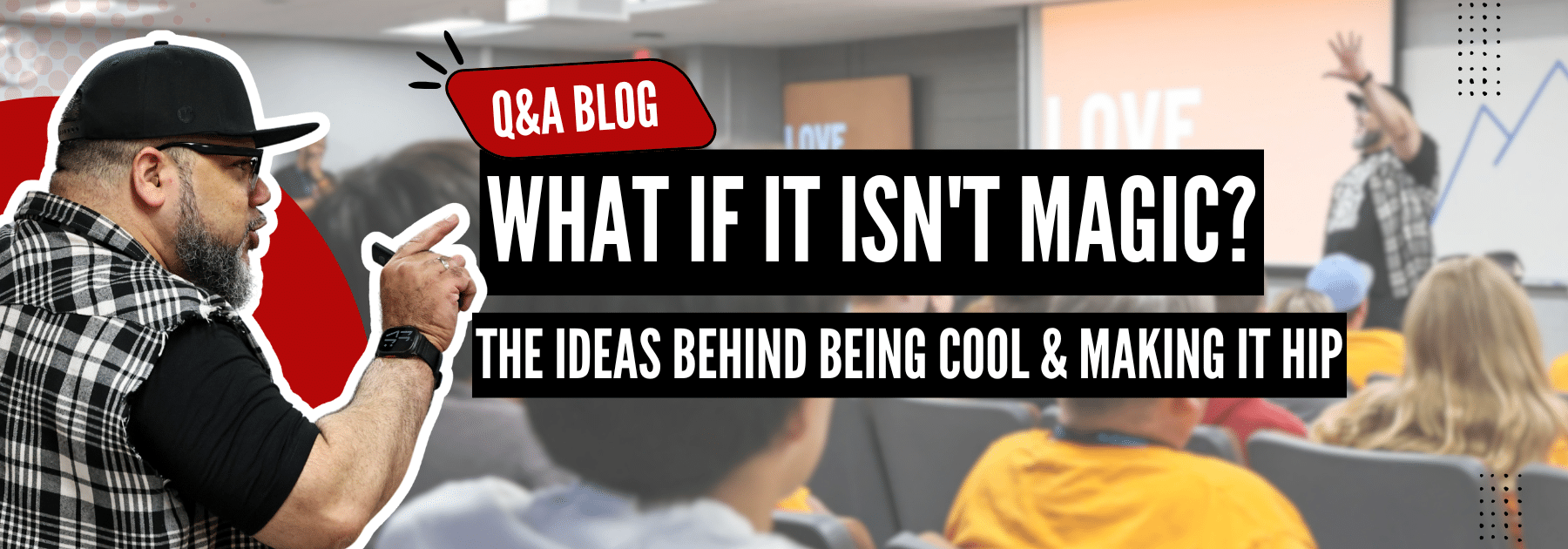
For years, educators, administrators, and conference attendees have watched Carlos Ojeda Jr. connect with students and create moments that seem almost impossible to explain.
Many have called it magic.
In his upcoming book, Being Cool & Making It HIP, Chu challenges that idea head-on. Instead of presenting engagement as a mysterious gift reserved for a select few, he argues that connection is a skill that can be learned, practiced, and refined.
We sat down with Chu to talk about the core ideas behind the book, what students really mean when they call an educator “cool,” and why connection must come before engagement.
The book opens with a bold statement: “I don’t believe in magic.” Why was that the right place to start?
Because most of the book is derived from that. For years, everyone called what we do magic. At first, I loved it because who doesn’t want to be called a unicorn? Who doesn’t want to be mystical and mysterious?
But over time, I found that to be a rationalization. A way for people to mask doubt and fear of their own abilities as educators. Because if something is magical, then it’s either one individual with special talents that can do it, or it’s mystical and doesn’t exist.
For me, that’s just not true.
The work that we do is scalable. It’s teachable. What people call “magic” is really trial and error, hard work, practice, study, research, and making connections.
All of those are skills educators already have. They may get dull, but they can be sharpened.
Before we can start working on making someone a better, more connected educational practitioner, we have to remove the idea that the work is magic. Because I don’t believe in that, I believe in them.
In the book, you redefine “cool” as connection. What do most educators misunderstand about what students mean when they say someone is “cool”?
Right off the bat, people think it’s because they’re funny, wearing trendy clothes, using slang, or trying to be young.
That couldn’t be farther from the truth… Cool is much more visceral than that.
It’s an educator who cared for them. An educator who helped them understand something they were struggling to get. Someone who took more time and listened.
Sure, it could be someone who’s funny or naturally connects well with people, but it’s much deeper than that. It has nothing to do with what we traditionally think of as cool.
It’s really about being caring, being real, being authentic, modeling behaviors, and treating students with the same respect that you want from them. It’s much deeper than the clothes you wear or the words you use.
One of the book’s core ideas is that you have to be COOL before you can be HIP. Why does connection come before engagement?
You can have an amazing curriculum, an amazing activity, or plan the perfect bus trip. But if there is no connection underneath it, those things fall flat.
That doesn’t mean they fail. It just means they won’t be as impactful as they could be.
When you make a connection, everything you teach becomes more meaningful because students trust you. I’ve often said that part of the reason our programming works is because we lead with connection.
We model the behaviors we want from students. We are vulnerable and show them that it’s okay to fail. In doing that, we earn a certain level of trust.
Then, when we say, “Okay, we’re going to teach you this,” students are much more willing to engage, whether it’s a writing workshop, leadership activity, or anything else.
Time and time again, students lean in more when there is a relationship underneath the experience. That’s very different from simply saying, “Here’s the activity. Go do it.”
Thinking about trust, why is authenticity so important?
Because it’s everything. Kids notice posers a mile away.
And in a world where everything feels fake, where even news is called fake news, and AI can create almost anything… honesty, authenticity, and realness are probably the greatest commodities adults can bring to young people.
They’re craving someone who is just honest. They don’t necessarily want someone who’s cool or trendy, even though that may be part of the package.
What they’re really looking for is someone authentic, caring, and real. Some of our best facilitators are not what people would traditionally call cool. But they are cool.
Because in the eyes of students, they care about them. They’re honest with them. And the only thing they want from them is success. It’s not transactional.
Why does every adult on a campus play a role in culture and climate?
Because everyone in that environment is affecting that student’s life. Sometimes it’s in those everyday moments that people lose sight of how much influence they actually have.
Students spend the majority of their youth on a school campus. The bus driver who picks them up has an impact before they ever walk through the school doors.
Everyone plays a role. The bus driver. The cafeteria worker. The front office staff. The custodian. The counselor. The teacher. The principal.
Everyone contributes to the culture.
When the first person you encounter that day is showing you love, care, and attention, what does that do to the trajectory of your day?
That’s why when we say, “It takes a village,” it really does. In many cases, school is the safest, most stable, most loving environment a young person experiences. As educators and educational practitioners, we’re helping shape that reality every single day.
If readers take away just one thing from this book, what do you hope it is?
That we can all be cool. We can all make connections.
This works beyond students. It works with adults. It works in everyday life. If I can make a connection with you, I can teach you something, learn something from you, or learn something together.
We can all be cool. We can all be HIP.
And if more of us practiced being cool and HIP on a regular basis, the world would be a much cooler place.
The Bottom Line for Carlos Ojeda Jr.
At CoolSpeak, we’ve spent more than two decades helping schools, districts, colleges, and youth-serving organizations strengthen connection, engagement, and culture.
Being Cool & Making It HIP is Carlos Ojeda Jr.’s effort to pull back the curtain and share the philosophy behind that work.
Because engagement isn’t magic. It’s built through trust. Through authenticity. Through relationships. Through intentionality.
And the good news? Those are skills every educator, administrator, counselor, coach, and youth advocate can learn.
If you’re looking to strengthen school culture, increase student engagement, or create more meaningful learning experiences, connect with the CoolSpeak team to learn more about our keynotes, workshops, professional development, and student programs.

0 Comments