
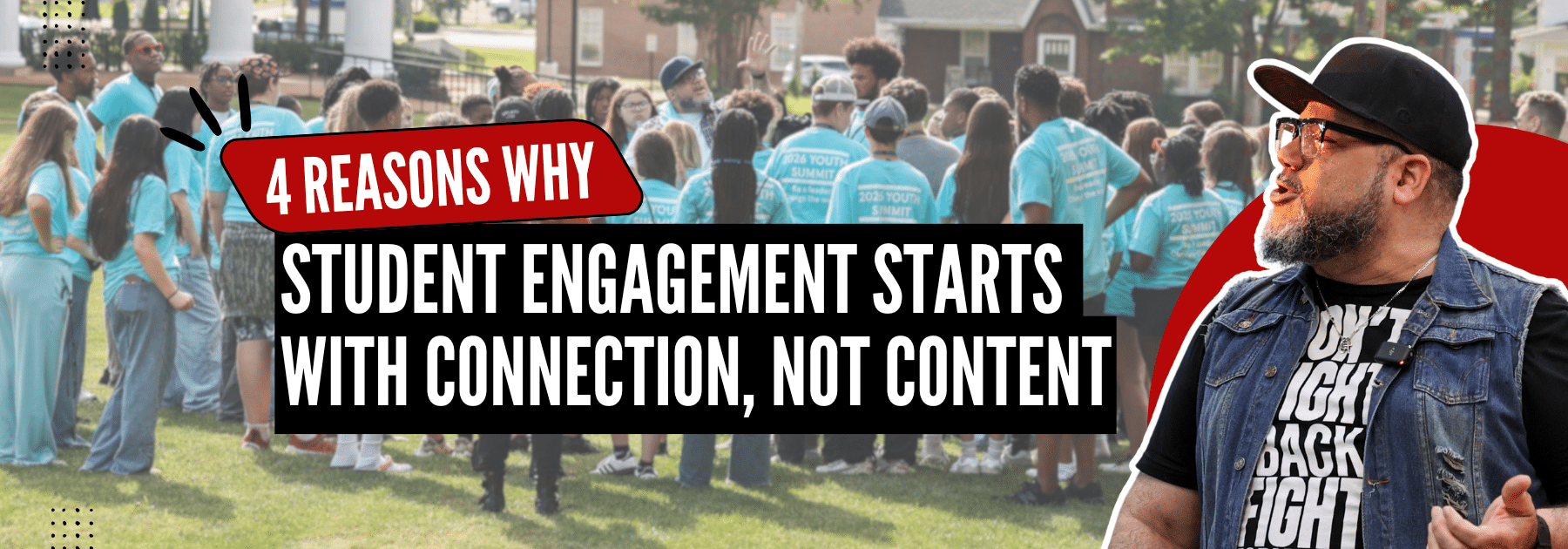
Schools across the country are investing in speakers, programs, initiatives, technology, incentives, assemblies, and countless other strategies designed to increase student engagement.
Yet many educators continue to ask the same question: Why aren’t students buying in?
As part of his upcoming book, Being Cool & Making It HIP, CoolSpeak CEO Carlos “Chu” Ojeda Jr. explores a challenge he believes sits at the center of many of today’s educational struggles: the growing disconnect between students and educators.
In this blog, Chu shares his thoughts on why connection matters, what happens when it breaks down, and why engagement can never fully happen without it.
The Real Problem Is Connection
If you asked me what the biggest challenge facing education is today, my answer would be simple: Connection.
Real, organic connection between students and educators.
I know we’re all tired of talking about COVID, but I don’t think we can ignore how significantly it impacted both students and teachers. There is still a tremendous amount of trauma from that experience, and in many ways, it created a divide between the people who need each other most.
Students are experiencing higher levels of anxiety, stress, and mental health challenges. Many feel misunderstood. Some genuinely believe their teachers don’t care about them or understand what they’re going through.
At the same time, educators are feeling many of the same things.
They feel disconnected.
They feel unappreciated.
They feel like students don’t care about learning or the educational process.
The interesting thing is that the data tells a very different story.
Most people can point to a teacher who had a positive impact on their life. Most students say teachers influence their self-esteem, their confidence, and even their dreams for the future.
We know teachers care.
We know students care.
But somewhere along the way, both sides stopped feeling it from each other.
Students pulled back.
Teachers pulled back.
And that distance has put a tremendous strain on the learning environment.
Why Some Programs Work and Others Don’t
Over the years, I’ve seen schools invest significant resources into programs, initiatives, speakers, events, and activities. Sometimes they create excitement, and sometimes they don’t.
The difference usually comes down to two things: Connection and design, and you can’t have one without the other.
You can have phenomenal content, incredible activities, and beautifully designed lessons. But if students don’t trust the person delivering them, they’ll engage at a much lower level.
The program might be good, but it won’t be great… and the opposite is true, too.
You can have incredible relationships with students. They can trust you, respect you, and enjoy being around you. But if your programming lacks intention, structure, and purpose, then you’re still leaving impact on the table.
That’s really where the COOL → HIP framework comes from.
The COOL part is connection, and the HIP part is High Impact Programming.
When you combine both, that’s when transformation happens.
Students are willing to participate.
They’re willing to take risks.
They’re willing to be vulnerable.
They’re willing to lean into learning.
And that’s where the magic, if you want to call it that, really happens.
What Changes When Connection Comes First
One of my favorite things to watch isn’t actually students. It’s educators.
When CoolSpeak comes into a school, a conference, or a camp and starts applying this framework, one of my favorite things to watch isn’t actually students. It’s educators.
I often see educators begin looking at their students differently.
Students who they thought were disengaged begin participating.
Students who they assumed wouldn’t listen begin leaning in.
Students who worried about begin showing curiosity, reflection, and growth.
I’ve watched educators have moments where they almost seem surprised, like they’re seeing their students through a different lens.
The students didn’t necessarily change overnight but the relationship changed, the connection changed… And once that happened, everything else became possible.
How Do We Know It’s Working?
One of the mistakes we make is assuming engagement means students are having fun but that’s really not enough.
A funny joke can get a laugh, and a fun activity can create participation, but let’s be clear, that doesn’t automatically mean learning happened.
When I design programs, I evaluate on multiple levels. I watch, I listen, I pay attention to what students are saying, writing, and reflecting on, and I look for evidence that they are thinking, feeling, or behaving differently because of the experience.
I ask myself:
- What do I want success to look like?
- What do I want it to sound like?
- What do I want students to say afterward?
Then we gather evaluations, collect feedback, and talk to the educators who know those students best.
When all those things line up, we know the experience created something meaningful.
Connection Changes Everything
At the end of the day, I don’t think education has an engagement problem; I think it has a connection problem. And connection isn’t about being trendy, slang, or trying to be young.
It’s about trust, authenticity, and helping people feel seen, valued, and understood.
That’s what the word “cool” has always meant to me because when people feel connected, they’re more willing to learn, participate, contribute, and grow.
And when that happens, everything changes.
From the Team at CoolSpeak
The ideas shared above are just a glimpse into Carlos “Chu” Ojeda Jr.’s upcoming book, Being Cool & Making It HIP, where he explores how connection creates the conditions for engagement and how intentional design transforms engagement into lasting impact.
If your school, district, conference, or organization is looking to strengthen student engagement, improve school culture, or reconnect students and educators, CoolSpeak’s team of speakers, trainers, and facilitators can help.
Because before you can make it HIP, you have to be COOL.

0 Comments