
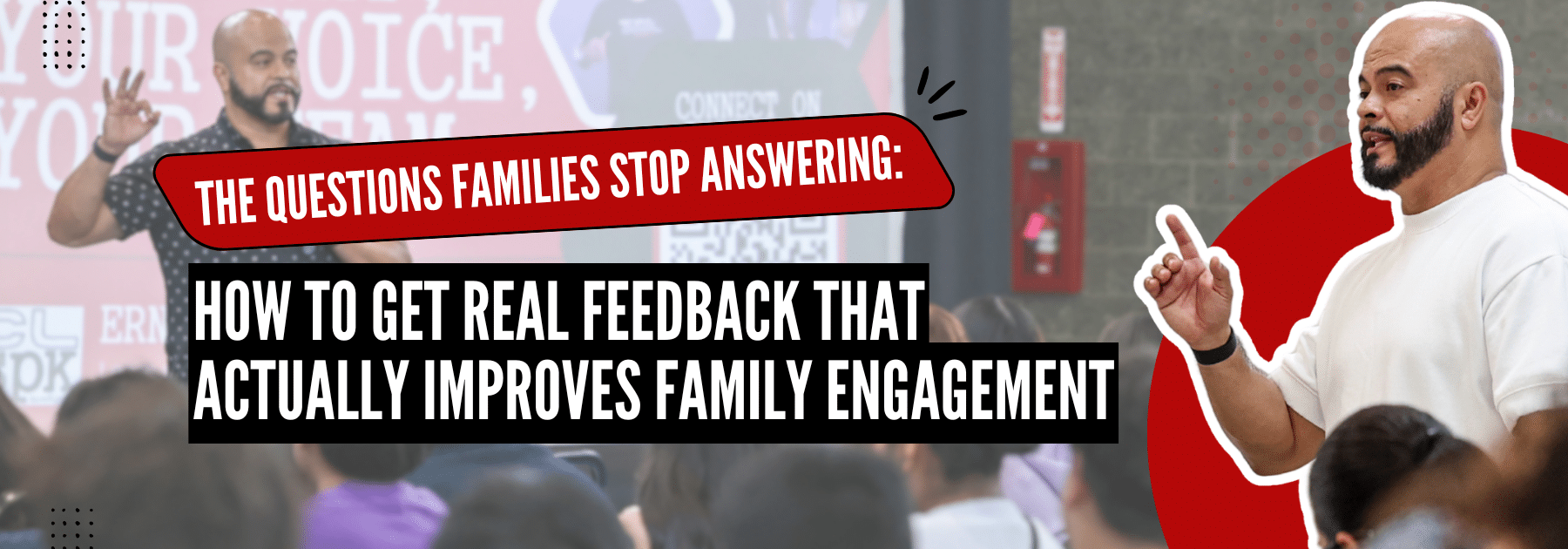
Because collecting data means nothing if families never see change.
Schools everywhere are asking an important question: How do we improve family engagement?
The good news is that many schools are trying. Surveys are sent. QR codes are shared. Feedback forms are distributed after events and family nights. Educators genuinely want to understand what families think and what could be done better.
But here is the challenge: Too often, schools ask families for feedback… and then nothing happens. Or at least, nothing visible enough for families to notice.
For family engagement expert and keynote speaker Ernesto Mejía, this is one of the biggest missed opportunities schools face today. After decades of working alongside schools, educators, migrant programs, multilingual families, and communities across the country, Ernesto has seen one truth rise to the surface again and again:
The goal is not to collect more feedback. The goal is to build more trust.
Because when families feel heard, respected, and valued, engagement grows naturally. When they feel ignored, participation disappears.
Why Families Stop Giving Feedback
Let’s be honest, most of us stop giving feedback when we feel like nobody is listening. At home. At work. In relationships. And your schools are no different.
Imagine calling someone for help, being told, “We’ll get back to you,” and then never hearing from them again. Eventually, trust breaks down. Eventually, you stop asking.
That same thing happens in schools. Families are often asked:
- How can we improve?
- What would you like to see?
- How was tonight’s event?
But if families never see those ideas implemented, or even acknowledged, why would they continue participating?
The power of feedback is not in collecting it. The power is in responding to it.
Trust grows when families see action. Participation grows when families realize their voice actually matters.
Ask Better Questions, Get Better Answers
Sometimes the problem is not that schools are not asking questions. It is that they are asking too many questions, or the wrong ones.
Long surveys with fifteen or twenty questions often leave families clicking answers just to finish. Overly formal wording or broad questions like “How can we improve family engagement?” can also make it harder for families to respond honestly or specifically.
Ask direct questions instead that lead to real, usable answers:
- What made you attend tonight?
- What made you feel welcome today?
- What is one thing we should continue doing?
- What could we improve next time?
- What topic would help your family most?
Simple questions create clarity. And clarity leads to action.
Families Open Up When They Feel Safe
Another major barrier to honest feedback? Fear.
Some families may worry about being judged. Others may fear being seen as “complainers.” Some may worry there will be consequences if they share frustrations openly. And for multilingual, migrant, immigrant, or refugee families, language barriers can make honest participation even harder.
That is why trust must come before evaluation. Families open up when they feel respected, not evaluated.
Sometimes the best feedback does not come from a survey at all, it comes through conversation with a trusted teacher, counselor, family liaison or any school relationship that already exists.
Sometimes the strongest insights come from simply asking and listening because family engagement is not just about collecting information.
It is about creating relationships where families feel safe enough to share honestly.
The Fastest Way to Lose Trust
Want to lose family trust quickly? Ask for feedback and disappear.
Families notice when their voices go nowhere. But they also notice when schools listen.
Something as simple as saying: “Thank you for suggesting afternoon meetings. That is why today’s event was scheduled earlier.” or “You shared that translation support mattered, so we improved our language services for tonight’s event.” can completely shift how families experience partnership.
When families see implementation, they feel ownership. When they feel ownership, engagement grows.
A Better Way to Gather Family Feedback
At the end of many of his workshops and family events, Ernesto uses something simple called a One-Minute Paper.
Anonymous. Quick. Actionable. Just two questions: 1) What worked well today? 2) What can we explain better next time?
No overwhelming survey, no twenty-question form… Just meaningful feedback that schools can actually use. Because the question is not just what are families saying?
The real question is: What are schools doing with what families say?
Family Engagement Improves When Trust Improves
The strongest family engagement efforts are not built on surveys alone, they are built on relationships. They are built when families feel seen, respected, appreciated, and heard.
And sometimes, improving family engagement starts with something as simple as asking better questions, and proving that the answers mattered.
Ready to Strengthen Family Engagement in Your School or District?
Great family engagement does not happen by accident. It happens when schools intentionally build trust, improve communication, and create experiences where families genuinely feel like partners in student success.
Through engaging keynotes, professional development, family nights, coaching, and implementation-focused workshops, Ernesto Mejía and the CoolSpeak team help schools move from involvement to meaningful engagement with strategies that are culturally relevant, relationship-centered, and designed for real-world implementation.
If your school or district is ready to strengthen trust, increase participation, and improve family engagement outcomes, let’s start the conversation. Explore how CoolSpeak can support your family engagement goals.

0 Comments